There are formulas that seem obvious in their original context, but which reveal a deep structure when they are observed geometrically from a higher dimension.
In this article we start from an algebraic identity —the Cauchy–Binet formula— applied to the Gram determinant, $ \det(A A^t) $ and we will show how it contains the Pythagorean theorem and Heron's formula, extended to any dimension.
Like the following documentary Flatland – What the Bleep Do We Know? which shows how a two-dimensional world discovers the third dimension:
The Gram formula makes an analogous leap: it takes Pythagoras and Heron out of their natural dimension and projects them into spaces of arbitrary dimension.
The Cauchy–Binet Formula
This is a purely algebraic identity, valid for any $n\times m$ matrix, with $n$ (number of rows) less than or equal to $m$ (number of columns), with no prior geometric interpretation.
Trivial example.
If $A = [a\ b]$, then \[ A A^t = [a^2 + b^2] \] and the maximal minors are $a$ and $b$.
The identity reduces to \[ a^2 + b^2 = a^2 + b^2, \] an obvious statement.
Non-trivial example.
Let us consider \[ A= \begin{pmatrix} 4 & -3 & -2\\ -1 & -2 & 0 \end{pmatrix}. \]
\[ A\,A^t= \begin{pmatrix} 4 & -3 & -2\\ -1 & -2 & 0 \end{pmatrix} \begin{pmatrix} 4 & -1\\ -3 & -2\\ -2 & 0 \end{pmatrix} \]The result is no longer evident, the identity holds.
In the following scene we can verify the identity with random 2x3 matrices.
Geometric meaning
Length of a vector in $\mathbb{R}^m$
Let $u=(11,2,10)$ be a vector in $\mathbb{R}^3$. By the Pythagorean theorem we know that its length is
\[ \|u\|=\sqrt{11^2+2^2+10^2}=15. \]
If $A$ is the matrix with a single row $(11\;2\;10)$, the length of its row vector, or its volume (1-volume), is
\[ \mathrm{vol}(A)=\sqrt{\det(A A^t)}. \]
Area of two vectors in $\mathbb{R}^m$
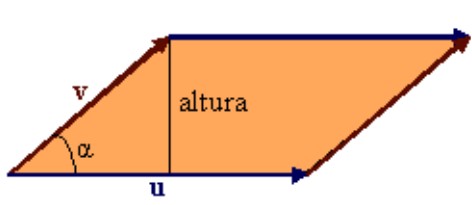
If $u$ and $v$ are two vectors in $\mathbb{R}^m$, the square of the area of the parallelogram they determine is given by:
\[ (\text{area})^2 =\|u\|^2\|v\|^2\sin^2(\alpha) =\|u\|^2\|v\|^2-(u\cdot v)^2 \]
\[ = \begin{vmatrix} u\cdot u & u\cdot v\\ v\cdot u & v\cdot v \end{vmatrix} =\det(A A^t), \]
where $A$ is the matrix whose rows are the vectors $u$ and $v$. Therefore, the area of the parallelogram is
\[ \mathrm{vol}(A)=\sqrt{\det(A A^t)}. \]
Volume of three vectors in $\mathbb{R}^m$
Let $A$ be the matrix whose rows are the vectors $u$, $v$ and $w$ in $\mathbb{R}^m$. The square of the volume of the parallelepiped they determine is
\[ (\mathrm{vol}(A))^2 = (\text{area})^2\cdot \text{height}^2 = \begin{vmatrix} u\cdot u & u\cdot v & 0\\ v\cdot u & v\cdot v & 0\\ 0 & 0 & \text{height}^2 \end{vmatrix}. \]
Taking into account that the height can be written as $\text{height}=\alpha u+\beta v+w$, one obtains
\[ = \begin{vmatrix} u\cdot u & u\cdot v & u\cdot\text{height}\\ v\cdot u & v\cdot v & v\cdot\text{height}\\ \text{height}\cdot u & \text{height}\cdot v & \text{height}\cdot\text{height} \end{vmatrix}. \]
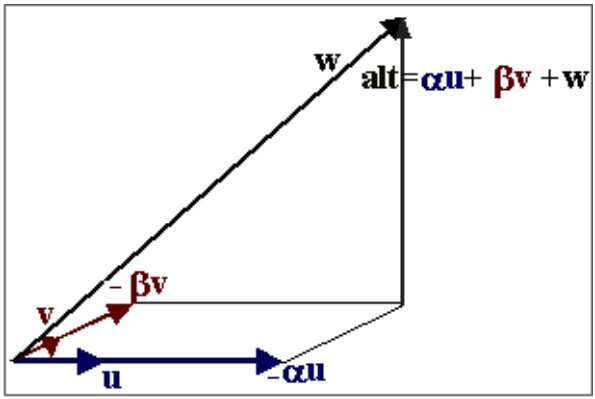
The previous determinant coincides with
\[ \det\!\left( \begin{pmatrix} u\\ v\\ w \end{pmatrix} \begin{pmatrix} u\\ v\\ w \end{pmatrix}^{\!t} \right), \]
and we finally conclude that
\[ \mathrm{vol}(A)=\sqrt{\det(A A^t)}. \]
The Heron formula
The Heron formula makes it possible to calculate the area of a triangle knowing only the lengths of its three sides. If a triangle has sides of length $a$, $b$ and $c$, and we denote by \[ s=\frac{a+b+c}{2} \] its semiperimeter, then its area is given by
\[ \text{Area}=\sqrt{s(s-a)(s-b)(s-c)}. \]
This expression is particularly remarkable because it does not require knowing angles or heights: all the geometric information of the triangle is encoded in the lengths of its sides.
At first sight, the Heron formula may appear isolated or even mysterious. However, we will see below that it is in fact a particular case of the fundamental equality studied in the previous section.
Heron as a Gram determinant
Let us consider a matrix $A$ with two rows, whose row vectors are $u$ and $v$. The associated Gram matrix is
\[ A A^t = \begin{pmatrix} u\cdot u & u\cdot v\\ u\cdot v & v\cdot v \end{pmatrix}. \]
If we denote \[ a=\lVert u\rVert,\qquad b=\lVert v\rVert,\qquad c=\lVert u-v\rVert, \] then,
\[ u\cdot v=\frac{a^2+b^2-c^2}{2}. \]
Therefore, the determinant of the Gram matrix takes the form
\[ \det(A A^t)= \det \begin{pmatrix} a^2 & \dfrac{a^2+b^2-c^2}{2}\\[0.6em] \dfrac{a^2+b^2-c^2}{2} & b^2 \end{pmatrix}. \]
This quantity coincides exactly with the square of the area of the parallelogram determined by the vectors $u$ and $v$, and therefore, with the square of twice the area of the associated triangle.
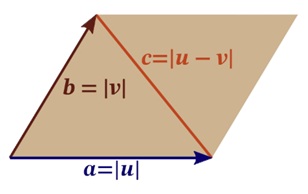
By expanding the determinant, one obtains an expression equivalent to the Heron formula that allows one to calculate the area of a triangle as a function of the lengths of its sides. In this way, the classical formula appears as a particular case of the identity
\[ (\mathrm{Vol})^2=\det(\text{Gram}), \]
applied to a matrix with two rows.
In the document heron2.pdf a detailed proof of this equivalence can be consulted, as well as its relation with the Cayley–Menger determinant.
Volume of a parallelepiped and the Heron formula in higher dimension
The square of the volume of a parallelepiped determined by several vectors can be expressed by means of the Gram determinant:
\[ (\mathrm{vol}(A))^2 = \det(A\cdot A^t). \]
This expression provides the volume of the parallelepiped as a function of the lengths of its edges and of the diagonals of its faces, constituting a natural extension of the Heron formula to higher dimensions.
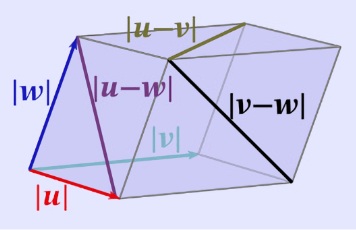
Let us see this in more detail. Let $A$ be a matrix with three rows, whose row vectors are $u$, $v$ and $w$. The associated Gram matrix is
\[ A A^t = \begin{pmatrix} u\cdot u & u\cdot v & u\cdot w\\ u\cdot v & v\cdot v & v\cdot w\\ u\cdot w & v\cdot w & w\cdot w \end{pmatrix}. \]
Therefore,
\[ \det(A A^t) = \det \begin{pmatrix} uu & uv & uw\\ uv & vv & vw\\ uw & vw & ww \end{pmatrix}. \]
Let us denote
\[ uu=a^2,\quad vv=b^2,\quad ww=c^2, \] \[ (u-v)^2=d_1^2,\quad (u-w)^2=d_2^2,\quad (v-w)^2=d_3^2. \]
Using the identity
\[ u\cdot v=\frac{u^2+v^2-(u-v)^2}{2}, \]
one obtains
\[ uv=\frac{a^2+b^2-d_1^2}{2},\qquad uw=\frac{a^2+c^2-d_2^2}{2},\qquad vw=\frac{b^2+c^2-d_3^2}{2}. \]
In this way, the volume of the parallelepiped can be calculated solely from the lengths of its edges and of the diagonals of its faces.
This determinant coincides, up to a constant factor, with the associated Cayley–Menger determinant:
\[ \det(A A^t) = \frac{1}{8} \det \begin{pmatrix} 0 & 1 & 1 & 1 & 1\\ 1 & 0 & a^2 & b^2 & c^2\\ 1 & a^2 & 0 & d_1^2 & d_2^2\\ 1 & b^2 & d_1^2 & 0 & d_3^2\\ 1 & c^2 & d_2^2 & d_3^2 & 0 \end{pmatrix}. \]
We thus conclude that the identity
\[ (\mathrm{vol}(A))^2=\det(A A^t) \]
constitutes a generalized Heron formula for parallelepipeds in arbitrary dimension, the order of the matrix $A$ being what determines the dimension of the volume considered.
Pythagoras in any dimension
The sum of the squares of the maximal order minors acts as a natural extension of the Pythagorean theorem.
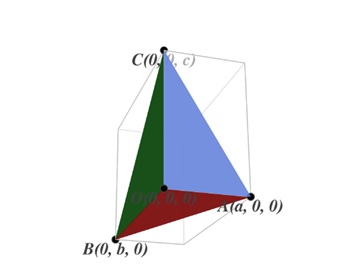
This statement, which directly generalizes the classical theorem of Pythagoras, will appear later as a particular case of a construction valid in any dimension.
The fundamental equality that we will use is
\[ (\mathrm{vol}(A))^2 := \sum (\text{maximal order minors of } A)^2. \]
When the matrix $A$ has a single row, this statement coincides exactly with the Pythagorean theorem for the length of a vector in the plane. When the number of rows increases, the same expression describes areas and volumes in higher dimensions.
The elementary case: a vector in the plane
If the matrix $A$ has a single row and two columns, then $A$ represents a vector in the plane, which we will write as $u=(u_1,u_2)$. In this case, the maximal order minors of $A$ coincide exactly with the coordinates of the vector.
Writing \[ (\mathrm{vol}(A))^2 = u_1^2 + u_2^2. \]
is to say that the square of the length of the vector $u$ is the sum of the squares of its components. We recognize here the classical Pythagorean theorem.
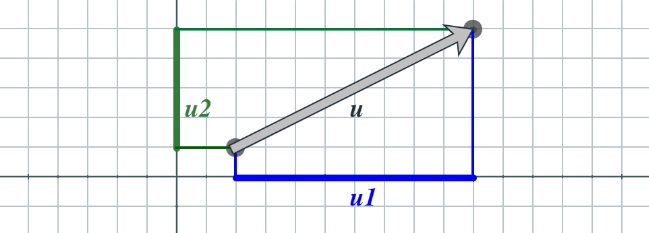
In the figure it is observed that the vector $u$ is decomposed into its projections onto the coordinate axes. The contribution of each projection appears squared, and their sum completely determines the length of the vector.
In this way, the Pythagorean theorem can be understood as the first case of a general construction: the square of the volume element is obtained as the sum of the squares of its projections.
Two vectors in space
Let us now consider a matrix $A$ with two rows and three columns. Its rows represent two vectors in space, \[ u=(u_1,u_2,u_3), \qquad v=(v_1,v_2,v_3), \] which determine a parallelogram in $\mathbb{R}^3$. In this case, the volume element is the area of that parallelogram.
The square of the area is given by the second member of the Cauchy–Binet equality, that is, by the sum of the squares of the maximal order minors of $A$:
\[ (\mathrm{vol}(A))^2 = \sum (\mathrm{men}_2(A))^2. \]
Geometrically, this expression has a very clear interpretation: each minor of order $2$ represents the oriented area of the projection of the parallelogram onto one of the coordinate planes $x=0$, $y=0$ or $z=0$.
\[ (\text{Area})^2 = (\text{Area}_{xy})^2 + (\text{Area}_{xz})^2 + (\text{Area}_{yz})^2. \]
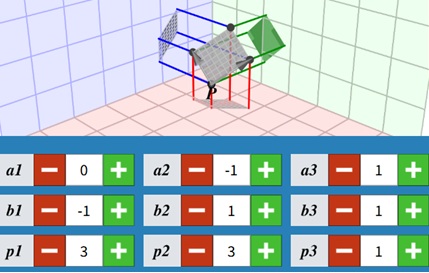
The figure shows the parallelogram determined by the vectors $u$ and $v$ and its projections onto the three coordinate planes. The total area of the parallelogram is completely determined by the areas of these projections.
If \[ A= \begin{pmatrix} 0 & -1 & 1\\ -1 & 1 & 1 \end{pmatrix}, \] the square of the area of the parallelogram determined by its rows is given by
\[ (\mathrm{area}(A))^2 = \sum (\mathrm{men}_2(A))^2. \]
The minors of order $2$ of $A$ correspond to the projections onto the coordinate planes and are obtained by eliminating, respectively, the $x$ column, the $y$ column and the $z$ column:
\[ \left(\det \begin{pmatrix} 0 & -1\\ -1 & 1 \end{pmatrix} \right)^2 + \left(\det \begin{pmatrix} 0 & 1\\ -1 & 1 \end{pmatrix} \right)^2 + \left(\det \begin{pmatrix} -1 & 1\\ 1 & 1 \end{pmatrix} \right)^2. \]
\[ = (0\cdot 1 - (-1)(-1))^2 + (0\cdot 1 - 1(-1))^2 + ((-1)\cdot 1 - 1\cdot 1)^2 \]
\[ = (-1)^2 + (1)^2 + (-2)^2 = 1 + 1 + 4 = 6. \]
Therefore, the square of the area of the gray parallelogram is $6$, and its area is $\sqrt{6}$.
This example explicitly shows that the square of the area of a parallelogram is the sum of the squares of the areas of its projections onto the planes $x=0$, $y=0$ and $z=0$.
In this way, the Pythagorean theorem extends to the case of area: the square of the area of a parallelogram is the sum of the squares of the areas of its projections. This result can be considered a Pythagorean theorem for areas, valid for two vectors in any dimension.
A particularly illustrative special case is the following. By choosing three positive values for a, b and c, the triangle determined by the points \((a,0,0)\), \((0,b,0)\) and \((0,0,c)\) is drawn. This triangle is half of the parallelogram determined by the difference vectors \((a,0,-c)\) and \((0,b,-c)\), placed with origin at the point \((0,0,c)\).
By applying the studied formula, the square of the area of this triangle turns out to be equal to the sum of the squares of the areas of its projections onto the coordinate planes. In other words, in a right tetrahedron, the square of the area of the hypotenuse face is equal to the sum of the squares of the areas of the three cathetus faces.
SUMMARY
Cauchy–Binet identity
\[ \det(A A^t) = \sum (\text{maximal order minors of } A)^2 \]
Computation of the volume of an $n$-parallelepiped
\[ (\mathrm{Vol}_n)^2 = \det(A A^t) \]
It makes it possible to compute the volume from the lengths of the edges
and of the diagonals of its $2$-faces.
It is the generalized Heron formula.
Generalized Pythagoras
\[ (\mathrm{Vol}_n)^2 = \sum (\text{maximal order minors of } A)^2 \]
Historical note
The identity \[ \det(A A^t)=\sum (\text{maximal order minors of }A)^2 \] is a particular case of the Cauchy–Binet formula, established at the beginning of the nineteenth century by Jacques Binet and Augustin-Louis Cauchy. This formula expresses the determinant of a product of rectangular matrices in terms of the minors of those matrices and constitutes one of the fundamental identities of linear algebra ( Cauchy–Binet).
When applying this identity to the product \(A A^t\), the matrix formed by the scalar products between the row vectors of \(A\) appears here, that is, the Gram matrix ( Gram matrix).
Throughout the nineteenth century, the determinant of this matrix —the Gram determinant— acquired a clear geometric interpretation: it represents the square of the volume element of the parallelepiped generated by a set of vectors in \(\mathbb{R}^n\). This reading connects the algebraic identity with classical problems of measurement, linear independence and metric geometry ( MacTutor – J. P. Gram).
From this point of view, the Cauchy–Binet formula provides a unifying framework in which the Pythagorean theorem and the Heron formula appear as particular cases of a single algebraic and geometric structure. The expression of area or volume solely in terms of lengths is generalized to arbitrary dimension by means of determinants, in particular through the Cayley–Menger determinant ( Cayley–Menger).
References
-
Geometry of the Determinant.
Lecture notes with visual scenes and explanations of the determinant and volume in spaces of arbitrary dimension.
Determinants (PDF) -
Proof of the Cauchy–Binet Formula.
General reference with a schematic proof: definition, statement, and a basic demonstration of the formula.
Wikipedia: Cauchy–Binet Formula -
Detailed Algebraic Proof of the Cauchy–Binet Formula.
Academic PDF presenting a formal proof using multilinear algebra.
The Cauchy–Binet Formula — Andrew Putman -
UNAM Teaching Unit.
This interactive unit from the Universidad Nacional Autónoma de México serves as the main foundation of the content of this article:
interactive scenes, visualizations, and explanations of volume in ℝⁿ.
UNAM – Volume in ℝⁿ -
ProofWiki: Cauchy–Binet Formula.
English reference with formal statements and variants of the formula.
ProofWiki – Cauchy–Binet Formula -
PlanetMath: Cauchy–Binet Formula.
Mathematical explanation of the identity in its canonical form.
PlanetMath – Cauchy–Binet Formula - Additional Academic References. Classical linear algebra textbooks where the Cauchy–Binet formula appears, for example: Shafarevich & Remizov, Linear Algebra and Geometry, §§2.9 and §10.5.