Introduction
This article presents an arithmetic formula that is as surprising as it is little known. Despite its conceptual simplicity, it is practically unknown even among students who have completed undergraduate studies in mathematics. However, it could easily be introduced in secondary education, for instance in the simplest case of \(2\times3\) matrices.
What is truly striking is that this identity leads to a generalization of the Pythagorean theorem that applies not only to geometric objects of any dimension — such as triangles, tetrahedra or, in general, n-simplices — but also to pairs of n-parallelepipeds in higher-dimensional spaces. This perspective helps us understand why the Pythagorean theorem, although formulated in terms of lengths or distances, naturally appears expressed through squares.
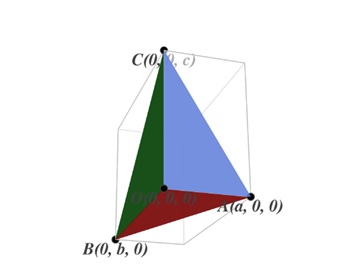
From an arithmetic point of view the formula is astonishing, since it relates apparently different expressions through an unexpected equality. But the surprise does not end there: it also admits a very suggestive geometric interpretation already in the \(2\times3\) case, where it appears as a relation between the areas of certain projections.
This geometric interpretation also invites us to consider possible generalizations to higher dimensions, where the formula connects with broader and deeper geometric structures.
To better understand the meaning of the formula, it is also useful to consult the page devoted to the particular case in which the matrices coincide, that is, when A = B. In that case the identity provides a suggestive generalization, in any dimension, of the theorems of Pythagoras and Heron, when considering objects of dimension n embedded in spaces of dimension m: see explanation of the case A = B.
The Cauchy–Binet Formula
For matrices \(A,B\in\mathbb{R}^{n\times m}\) with \(n\le m\) we have
where the sum runs over all maximal minors.
In dimension \(2\times3\) three minors appear:
We can verify this equality for random matrices.
Geometric Interpretation
The scalar identity
can be extended to \(2\times3\) matrices.
We define the scalar product of two matrices as
Geometrically,
Interactive Visualization
In \(\mathbb{R}^3\) the area of a parallelogram has no sign, since it can be observed from both sides of the plane.
However, when we project the parallelogram generated by the rows of A onto the plane generated by the rows of B, both parallelograms lie in the same plane.
Within that plane an orientation does exist.
If the pairs of vectors (B1, B2) and (A′1, A′2) have the same orientation, the determinant det(ABt) is positive.
If the orientation is opposite, the determinant is negative.
Proof that $\det(AB^t)$ equals the area of $B$ times the area of the projection of $A$ onto $B$
Let $A$ and $B$ be two $2\times3$ matrices whose rows represent pairs of vectors in $\mathbb{R}^3$. We will see how the following equality is obtained.
Let $u$ and $v$ be the row vectors of $B$. These two vectors generate a plane in $\mathbb{R}^3$. If $\nu$ is a unit vector perpendicular to that plane, then $\{u,v,\nu\}$ forms a basis of the space.
Each row vector of $A$ can be written as
where the term $c\nu$ is the component perpendicular to the plane of $B$. The orthogonal projection onto that plane removes precisely this component.
The projection of the previous vector onto the plane generated by $u$ and $v$ is
Therefore the scalar products with $u$ and $v$ are
The matrix $AB^t$ turns out to be
where $M$ is the coordinate matrix of the projection of $A$ in the basis $\{u,v\}$.
The projection of $A$ onto the plane generated by $B$ is
The square of its area is
Using properties of the determinant,
Thus
Multiplying by $$ (\operatorname{Area}(B))^2=\det(BB^t) $$ we obtain
And since $$ AB^t=MBB^t $$
We conclude that
The sign is positive when the orientation of $\mathrm{proy}_B(A)$ coincides with that of $B$ in the plane they generate.
The same reasoning is valid for matrices $A$ and $B$ of size $n\times m$. In that case $\det(AB^t)$ represents the product of the $n$-dimensional volume generated by the vectors of $B$ and the volume of the orthogonal projection of the vectors of $A$ onto the subspace generated by $B$.
Interpretation of the Second Member
The second member of the Cauchy–Binet formula can be interpreted as the sum of the products of the projections of the parallelograms onto the coordinate planes
Each minor corresponds to one of these projections.
Conclusion
The Cauchy–Binet formula expresses a very general geometric relation between volume elements.
If \(A,B\in\mathbb{R}^{n\times m}\) with \(n\le m\), the determinant
can be interpreted as the product between:
- the volume element generated by the rows of \(B\)
- and the volume element of the projection of the parallelogram (or parallelotope) generated by \(A\) onto the subspace generated by \(B\).
The Cauchy–Binet formula states that this product coincides with
that is, with the sum of the products of the volume elements of the projections of \(A\) and \(B\) onto all the subspaces generated by groups of \(n\) vectors of the canonical basis.
Geometrically, these subspaces are obtained by fixing \(m-n\) coordinates equal to zero.
Example with \(2\times5\) matrices
If we now consider matrices
more combinations of minors appear, since we must choose two columns among five.
The number of terms is
For example, consider
The Cauchy–Binet formula gives
Each term corresponds to the product of the area elements of the projections of the parallelograms of \(A\) and \(B\) onto one of the coordinate planes of the space \(\mathbb{R}^5\).
Thus the Cauchy–Binet formula expresses that the product between the volume element generated by the rows of \(B\) and the volume element of the projection of the parallelogram of \(A\) onto the subspace generated by \(B\) can be computed by summing the contributions of all the projections onto the coordinate subspaces.
Each index \(I\) corresponds to choosing a set of \(n\) coordinates among the \(m\) available; geometrically this amounts to projecting the parallelograms of \(A\) and \(B\) onto the subspaces obtained by setting \(m-n\) coordinates equal to zero.
SUMMARY
Cauchy–Binet formula
Geometric interpretation of the first member
The determinant of the product measures the product between the volume element generated by the rows of \(B\) and the volume element of the parallelogram obtained by projecting \(A\) onto the subspace generated by \(B\).
Geometric interpretation of the second member
Each term corresponds to the product of the areas of the projections of the parallelograms of \(A\) and \(B\) onto one of the coordinate subspaces of dimension \(n\), obtained by setting \(m-n\) coordinates equal to zero.
Thus the second member represents the sum of the products of the volume elements of the projections of \(A\) and \(B\) onto all the \(n\)-dimensional coordinate subspaces.
Scalar product between matrices
This identity allows us to define a scalar product between matrices \(n\times m\) with \(n\le m\).
The Cauchy–Binet formula shows that this scalar product admits two geometric interpretations:
- as the product between the volume generated by \(B\) and the volume of the projection of \(A\) onto the subspace generated by \(B\);
- as the sum of the products of the projections of \(A\) and \(B\) onto all the \(n\)-dimensional coordinate subspaces.
In this way we obtain an extension of the scalar product of vectors, whose two classical interpretations are:
Epilogue
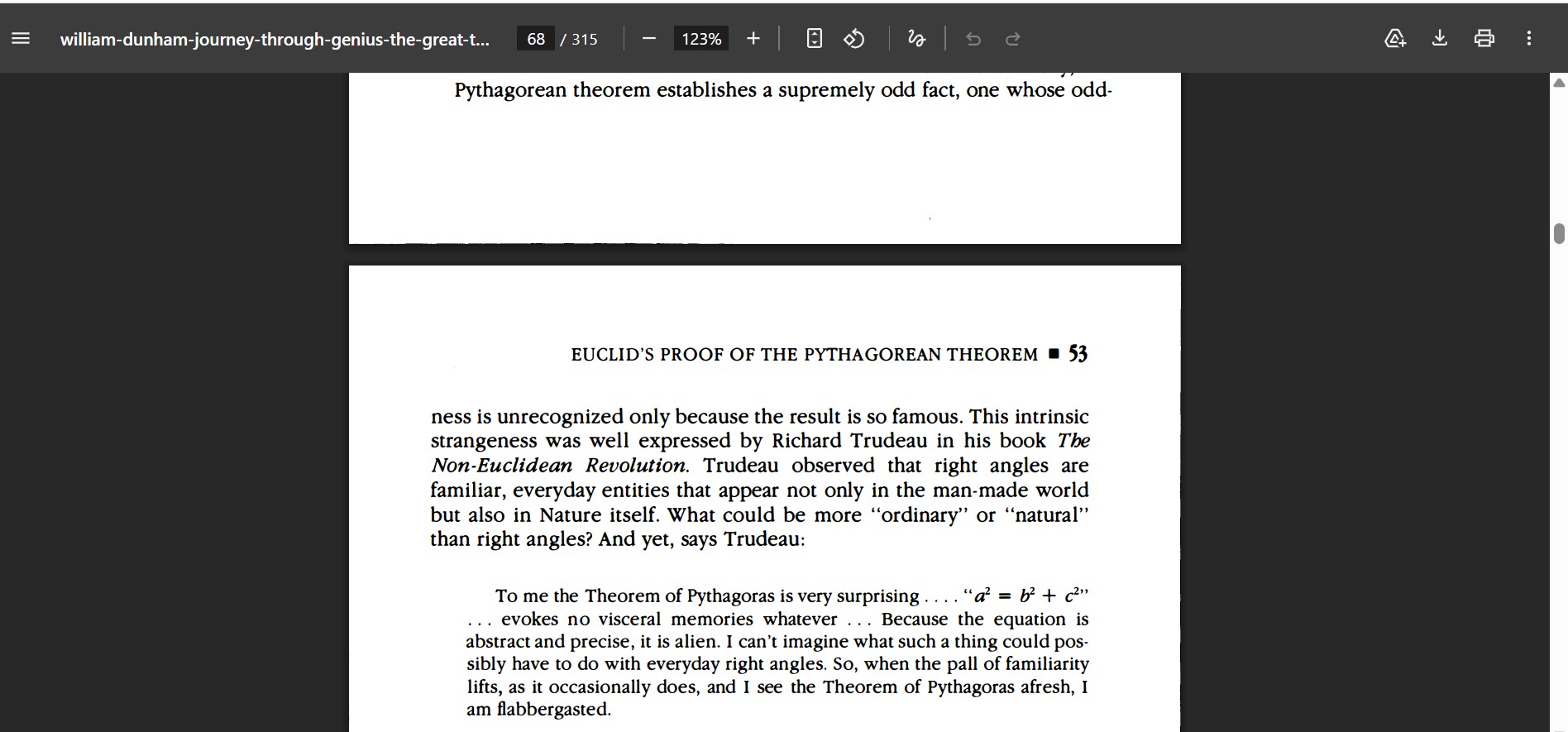
The surprising character of certain mathematical identities becomes clearer when we look with fresh eyes at a relation that has become overly familiar. William Dunham captures this idea by quoting Richard Trudeau:
— William Dunham, Journey Through Genius, quoting Richard Trudeau, The Non-Euclidean Revolution.
If we now return to the Cauchy–Binet identity, we can better understand why in the Pythagorean theorem squares always appear, rather than cubes or higher powers when the dimension increases. The reason is that the theorem is only a particular case of a much more general formula. When in this identity we take \(B=A\), the terms that appear are necessarily squares.
From the perspective provided by the parallelogram law, the Pythagorean theorem does not actually depend on the presence of right angles.
Thus the surprising relation between the sides of a right triangle is not an isolated phenomenon, but rather the concrete manifestation of a much more general structure summarized by the Cauchy–Binet formula.
OBSERVATION 1
Why can we speak of the \(n\)-parallelepiped determined by the row vectors of a matrix?
Because through a point outside a line there passes exactly one parallel line (Euclid’s fifth postulate in the Elements).
OBSERVATION 2
Arithmetic (or algebra) and geometry maintain a remarkably fruitful relationship. Often they illuminate one another: algebra provides precision and generality, while geometry offers intuition and visual clarity, both contributing to the beauty of mathematical understanding.
However, they are not always necessarily linked, nor does their relationship take a single form. For example, the fact that \(3\times4=12\) does not have to be interpreted exclusively as the area of a rectangle with base 3 and height 4, nor even as that of a parallelogram. The product can also appear as the number of pieces in a decomposition of the plane into a basis of figures, which may take very different shapes.
OBSERVATION 3
Presenting mathematics in a constructive spirit is especially valuable. It shows that mathematics is not a rigid set of fixed rules, but rather an activity of building ideas. This construction does not consist in wandering aimlessly, but in guiding thought toward structures that already belong to the mathematical edifice and that have gradually been consolidated throughout history.
From this perspective it might also be desirable to move away from a certain approach based on “how clever are you?”, often present in puzzle-type problems presented as isolated riddles without context. Rather than measuring momentary cleverness, mathematical learning should encourage progressive understanding and the connection between ideas.
In many educational programs one precisely misses this guiding thread that allows us to understand how concepts arise, how they relate to one another, and how they eventually fit into broader mathematical structures.